Physicist Cover Letter Example (2026)
By FindAJobAI Team Updated How we built this page
Hiring managers read physicist cover letters to find out whether your research will turn into results for their team. A strong letter names the physical systems and tools you know, tells one story about an experiment or model in plain words and shows that you can work toward a product, a deadline or a shared research goal. Keep the theory short and let the measured results do the talking.
Physicist cover letter template
This letter as a one-page template: an opening that names the job and your strongest fact, proof that answers the ad, a reason for this employer and a short close.
After you sign up, FindAJobAI drafts your own letter for a real job from your CV in this format, and you edit it before you send it.
Example 1 · Experienced
Optics postdoc applying for an industry metrology physicist role
Rosalind is a postdoc in a laser physics group. The ad is for a physicist building optical measurement tools at a semiconductor equipment company.
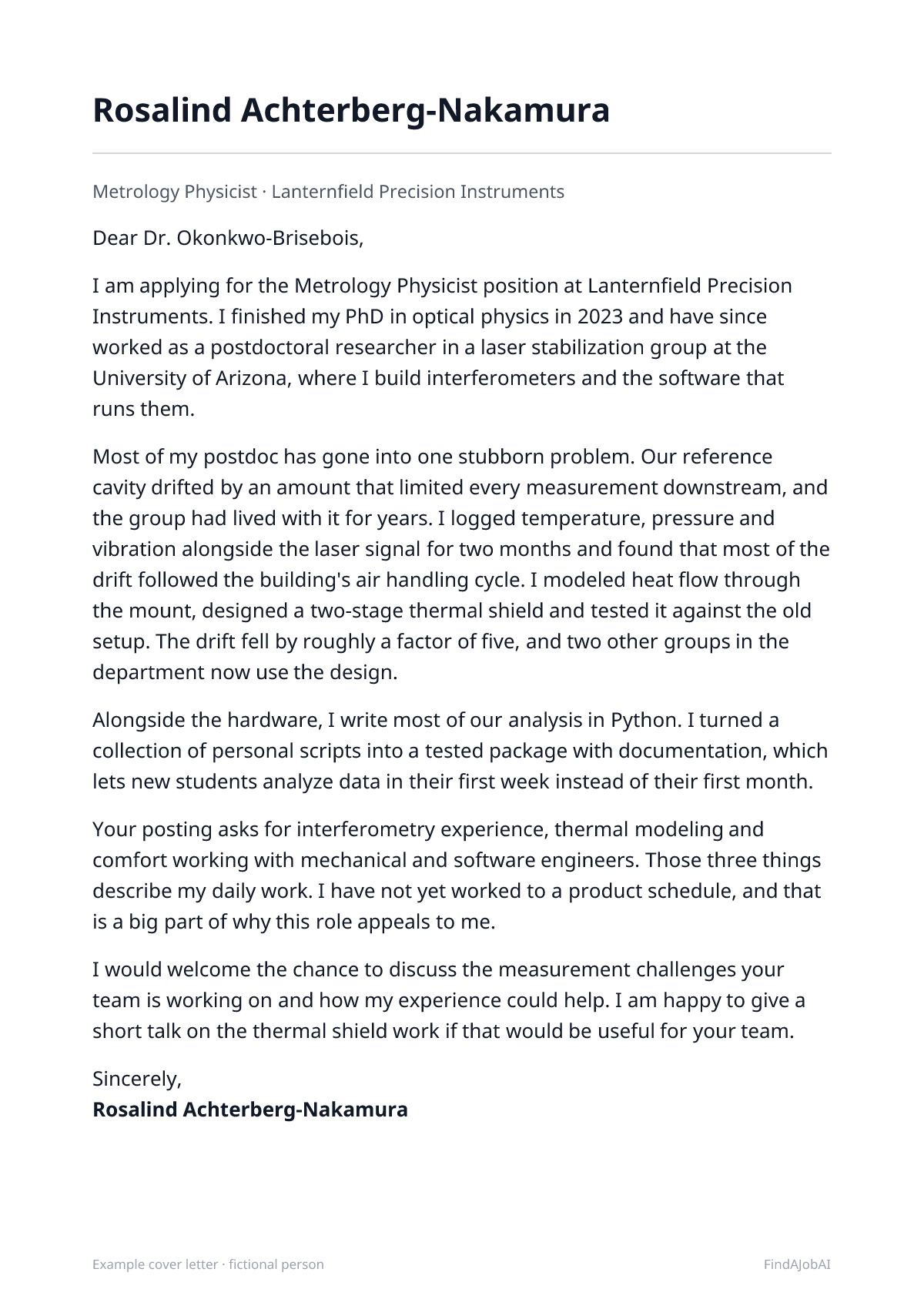
Example letter · fictional
Dear Dr. Okonkwo-Brisebois,
I am applying for the Metrology Physicist position at Lanternfield Precision Instruments. I finished my PhD in optical physics in 2023 and have since worked as a postdoctoral researcher in a laser stabilization group at the University of Arizona, where I build interferometers and the software that runs them.
Most of my postdoc has gone into one stubborn problem. Our reference cavity drifted by an amount that limited every measurement downstream, and the group had lived with it for years. I logged temperature, pressure and vibration alongside the laser signal for two months and found that most of the drift followed the building's air handling cycle. I modeled heat flow through the mount, designed a two-stage thermal shield and tested it against the old setup. The drift fell by roughly a factor of five, and two other groups in the department now use the design.
Alongside the hardware, I write most of our analysis in Python. I turned a collection of personal scripts into a tested package with documentation, which lets new students analyze data in their first week instead of their first month.
Your posting asks for interferometry experience, thermal modeling and comfort working with mechanical and software engineers. Those three things describe my daily work. I have not yet worked to a product schedule, and that is a big part of why this role appeals to me.
I would welcome the chance to discuss the measurement challenges your team is working on and how my experience could help. I am happy to give a short talk on the thermal shield work if that would be useful for your team.
Sincerely,
Rosalind Achterberg-Nakamura
Example 2 · Entry level
New physics graduate applying for a research associate role
Benedikt has a BS in physics and two years of undergraduate research. The ad is for a research associate in a materials physics group at a national laboratory.
Example letter · fictional
Dear Dr. Petrakis-Adebayo,
I am writing to apply for the Research Associate position in your materials physics group at Gallatin Basin National Laboratory. I will complete my bachelor's degree in physics at Montana State University this May, after two years of research in a condensed matter lab on campus.
In that lab I measured electrical transport in thin films at low temperatures. My main contribution was practical. Each measurement run took three hours because the lock-in readings were recorded by hand. I wrote a Python program that controlled the instruments and saved the data with full metadata, which brought a run down to under an hour and removed a common source of copying errors. The group still uses it. Writing it also taught me to read instrument manuals closely and to test code against known results before trusting it.
For my senior thesis I measured the superconducting transition in six niobium films and compared the results with published values. Most of the work was learning to trust the data: checking contacts, repeating runs and writing honest error bars. My advisor asked me to present the final results at our department research day, where I answered questions from faculty in three different groups.
Your group's work on quantum materials is the area I most want to learn. I would bring careful lab habits, reliable code and a strong wish to learn from experienced scientists. I am comfortable with long measurement runs, keep a clear lab notebook and follow safety rules for cryogens and high voltage.
I would be glad to talk about the role and the projects a new associate might join.
Best regards,
Benedikt Oyelaran-Fitzwilliam
Example 3 · Senior or lead
Principal physicist applying to direct an R&D physics group
Lysandra leads a photonics team at a sensor company. The ad is for a director of physics R&D at a company building quantum sensing products.
Example letter · fictional
Dear Ms. Brightwell-Asamoah,
I am applying for the Director of Physics R&D role at Aurelian Quantum Sensing. I have fifteen years of experience in photonics and precision measurement, and for the last six I have led a group of nine physicists and engineers at Corvane Sensor Systems in Rochester.
When I took over the group, our prototypes performed well in the lab but often failed their first field trials. The problem was not the physics. It was that our test plans ignored temperature swings, vibration and the way customers actually mounted the sensors. I brought field engineers into design reviews from the start, set up a small environmental test lab and agreed field-ready criteria with product management. Over the next three product cycles, every new sensor passed its first field trial.
I still stay close to the technical work. I review the group's models and uncertainty budgets, hold several patents in optical sensing, review test data every week and spend time with customers when a measurement does not match their expectations. I believe a group lead who still reads the models catches problems earlier than one who only reads summaries.
Aurelian is moving from research prototypes toward its first commercial product. I would spend my first months understanding the current designs and the people behind them, then build a shared plan with product and manufacturing for the path to a field-ready sensor.
I would welcome a conversation about your product timeline and the team you want to build. I would be happy to share examples of the test plans and design review checklists my group uses today.
Kind regards,
Lysandra Quigley-Obiora
All three letters, and the short version below, are fictional: the people, employers and numbers are invented. Borrow the structure, never the facts.
- Prefer to write it yourself? Use the free cover letter template.
- Check your CV against the job first: the free CV score shows the missing keywords.
Why the first letter works, paragraph by paragraph
Paragraph 1: Opening
Gives the degree, year, current position and the kind of hardware and software the writer builds, which tells a hiring manager the fit in two sentences.
Paragraph 2: The cavity drift story
Walks through a real investigation: data logged, a cause found, a model, a design tested against the old one and a measured improvement that others adopted.
Paragraph 3: Software skills
Shows that the writer's code helps others, which matters for industry teams that share tools and data.
Paragraph 4: Requirements mapped to daily work
Maps three requirements to daily work and honestly names the missing product experience as a reason for the move.
Paragraph 5: Close
Turns attention to the team's measurement problems and offers a conversation without repeating the letter.
What the entry-level letter does differently
The graduate's letter shows maturity through two small things: code that removed copying errors and a thesis that focused on trusting the data. Both matter more to a research group than a long list of courses.
What the senior letter does differently
A senior physicist letter talks about turning physics into reliable products: test plans, design reviews, field trials and teams. It keeps one sentence of hands-on credibility and ends with a plan tied to the company's next milestone.
Short physicist cover letter: an email-ready version
Many applications arrive as an email or a small text box, and a full page doesn't fit. This version runs 120 to 150 words and keeps only what a reader needs to decide whether to reply. A computational physicist replies by email to a hiring manager who posted a simulation physicist role at an energy storage startup.
Short version · email · fictional133 words
Subject: Simulation Physicist – PhD, 4 years multiphysics modeling – Fenwick Adeyemi-Castellano
Hi Dr. Valdivia-Mensah,
I am writing about the Simulation Physicist opening at Brightcove Battery Labs. I hold a PhD in computational physics and have spent four years building multiphysics models of heat and ion transport for a battery research group.
My models are tied closely to experiment. Last year I calibrated a thermal model against cell test data and used it to suggest a cooling layout that the hardware team then built and confirmed in testing. I write in Python and C++ and run large jobs on a shared computing cluster.
My resume and two short code samples are attached. I can meet any day this week to talk about the lab. I am also glad to complete a short modeling exercise if that is part of your process.
Thank you,
Fenwick Adeyemi-Castellano
The short version leads with the degree, the modeling area and years of experience, then gives one example where simulation guided real hardware. A busy hiring manager can judge fit quickly.
Opening lines that work for physicist cover letters
The first sentence decides whether the second gets read. Here are six openings, one for each situation you might be in. Pick the one that matches yours and swap in your own facts: every name and number below is invented.
1. You have a standout result
For two years I chased a drift in our reference cavity that the group had lived with for a decade, and the fix is now used across the department.
2. The ad names a problem you've solved
I build interferometers by day and the Python tools that analyze them by night, and I would like to bring both to your metrology team.
3. Someone referred you
After two years measuring thin films at four kelvin, I am ready to join a national lab group working on quantum materials.
4. You admire what they build
Your senior scientist, Thaddeus Marchetti-Owusu, suggested I apply after we discussed his group's sensor work at a recent optics conference.
5. You're new to the field or switching into it
Every result I report comes with an honest error bar, which is why the groups I work with trust my measurements.
6. You have senior scope or a specialism
As a group lead who has taken three sensor generations from the lab to the field, I know where physics projects usually stall.
How to write a physicist cover letter
Five steps, in the order you'd write them. The shape stays the same for every job (a short opening, proof, a reason for this employer, a close), and what goes into each part is what changes with the role.
Open with your area and tools
In your first two sentences, give your degree, your research area and the systems or software you work with most. A hiring manager in R&D sorts letters by technical fit, so name the physics and the tools clearly instead of opening with a general statement about curiosity.
Tell one experiment or model story
Choose a problem you solved, such as noise, drift or a model that did not match data. Describe what you measured, the cause you found, what you built or changed and the improvement. Explain it the way you would to an engineer in another field.
Show your work helped others
Mention code, designs or methods that colleagues adopted, students you trained or a result a product team relied on. Employers hire physicists to make teams stronger, so evidence that others used your work carries real weight.
Explain the move between sectors
If you are moving from academia to industry, or the other way, say why in one or two sentences. Name what attracts you, such as product schedules or longer research horizons, so the reader does not have to guess your motives.
Close on the team's problems
End by connecting your skills to the group's measurement, modeling or product challenges and offering a conversation. Keep it short, and avoid repeating your resume in the final paragraph. A short, specific ending leaves the reader with your strongest evidence fresh in mind.
Physicist cover letter do's and don'ts
Do
- Name the physical systems, instruments and software you use, in plain words.
- Tell one experiment or modeling story with a measured result.
- Show how your work helped other people, such as tools, designs or code they adopted.
Don't
- Don't paste your thesis abstract; describe what you built and what it achieved.
- Don't list every technique you have read about; managers will ask about each one.
- Don't hide the move from academia to industry; explain why the change appeals to you.
Common physicist cover letter mistakes
Each one is easy to make and quick to fix before you send the letter.
Writing a research statement instead of a letter
Cut long theory and keep to what you built, measured and delivered, with one clear result.
Ignoring programming skills
Name the languages and tools you use, because most physics roles now include serious coding.
Inflating your results
Give honest figures with context and avoid claiming credit for a whole group's work.
Using the same letter for labs and companies
Adjust the focus: research questions and papers for labs, products and timelines for companies.
Email subject lines for physicist applications
Applying by email? Put the job title, any reference number and your name in the subject line.
- Metrology Physicist – PhD optics, interferometry and Python – Rosalind Achterberg-Nakamura
- Research Associate, Materials Physics – BS Physics 2026 – Benedikt Oyelaran-Fitzwilliam
- Director of Physics R&D – 15 years photonics, group lead – Lysandra Quigley-Obiora
Everything for Physicists
- Physicist resume exampleA full resume, plus bullet and summary examples
- Physicist interview questions30 questions with sample answers
- Physicist job descriptionDuties, skills and requirements
- Cover letter with no experience: templates
Other cover letter examples
Physicist cover letter FAQ
What should a physicist cover letter include?
Your degree and research area, the instruments, models and software you use, one story about an experiment or analysis with a measured result and why the team's work interests you. Keep it to one page.
How do I write a physicist cover letter for an industry job?
Translate research into practical results: precision reached, time saved, designs adopted or code others use. Mention teamwork with engineers and say clearly why you want to work toward products and schedules.
Should a physicist cover letter mention publications?
Briefly. For research roles, name one or two papers that match the group's work. For industry roles, a single line is enough, and the letter should focus on what you built and measured.
How we built this page
The FindAJobAI team wrote the three example letters, the short email version, the opening lines and the advice for physicist roles. The people, employers and numbers in the letters are invented; the structure, the kind of evidence and the order of the paragraphs are the parts to copy.
Once we track enough live physicist job ads, this page also shows the skills they ask for most, counted the same way as our in-demand skills report.
Last reviewed on November 1, 2026.