Actuary Cover Letter Example (2026)
By FindAJobAI team Updated How we built this page
Actuary ads lean on exam progress and credentials, so a cover letter earns its place by showing what you did with the numbers: a rate that was wrong, a reserve that moved, a model that changed how leadership priced risk. Name the line of business and the decision, not just the exams passed.
Actuary cover letter template
This letter as a one-page template: an opening that names the job and your strongest fact, proof that answers the ad, a reason for this employer and a short close.
After you sign up, FindAJobAI drafts your own letter for a real job from your CV in this format, and you edit it before you send it.
Example 1 · Experienced
Pricing actuary applying to a regional auto insurer
Soren prices personal auto at a mid-size carrier. The ad asks for GLM experience and work with underwriting on rate filings.
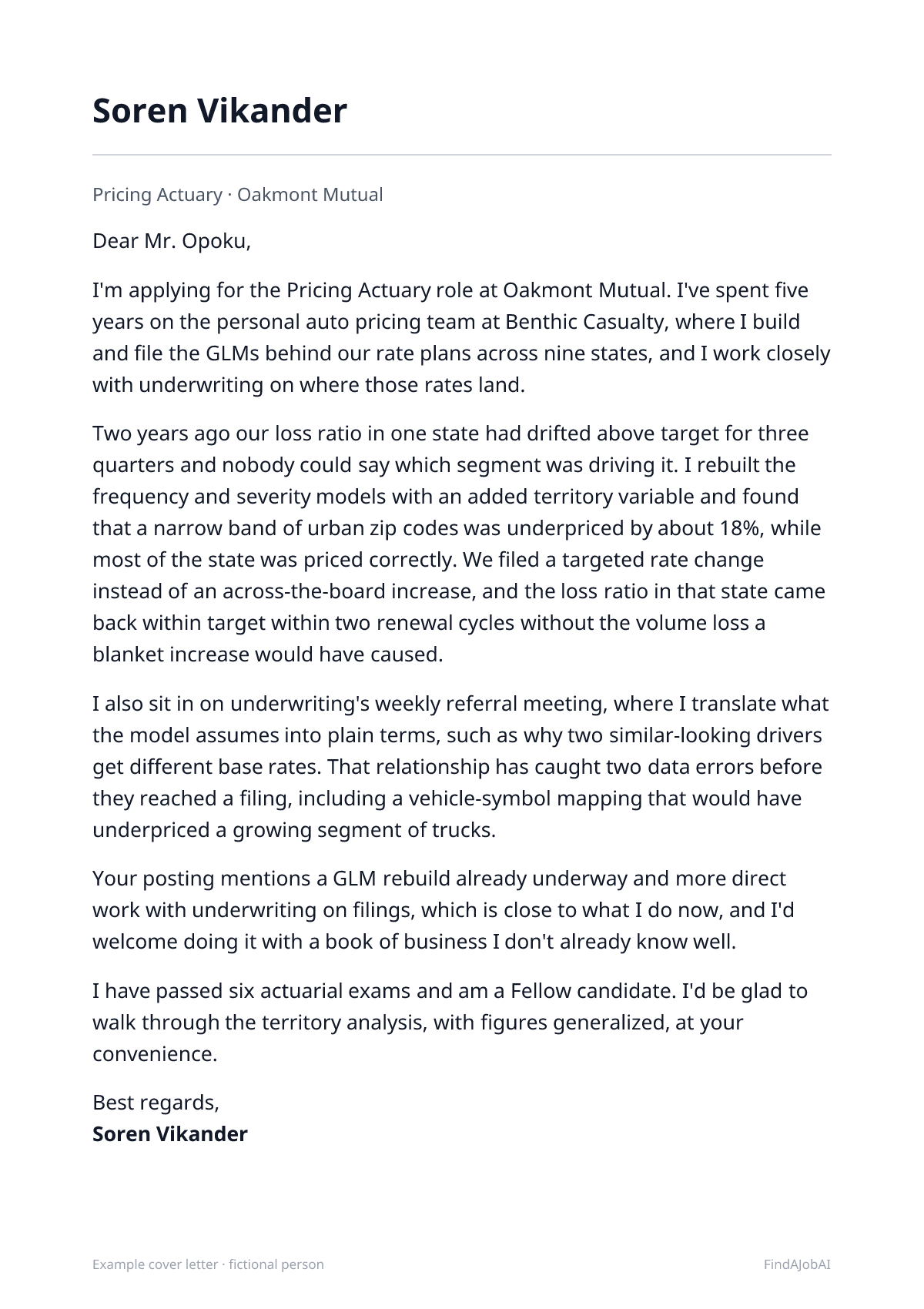
Example letter · fictional
Dear Mr. Opoku,
I'm applying for the Pricing Actuary role at Oakmont Mutual. I've spent five years on the personal auto pricing team at Benthic Casualty, where I build and file the GLMs behind our rate plans across nine states, and I work closely with underwriting on where those rates land.
Two years ago our loss ratio in one state had drifted above target for three quarters and nobody could say which segment was driving it. I rebuilt the frequency and severity models with an added territory variable and found that a narrow band of urban zip codes was underpriced by about 18%, while most of the state was priced correctly. We filed a targeted rate change instead of an across-the-board increase, and the loss ratio in that state came back within target within two renewal cycles without the volume loss a blanket increase would have caused.
I also sit in on underwriting's weekly referral meeting, where I translate what the model assumes into plain terms, such as why two similar-looking drivers get different base rates. That relationship has caught two data errors before they reached a filing, including a vehicle-symbol mapping that would have underpriced a growing segment of trucks.
Your posting mentions a GLM rebuild already underway and more direct work with underwriting on filings, which is close to what I do now, and I'd welcome doing it with a book of business I don't already know well.
I have passed six actuarial exams and am a Fellow candidate. I'd be glad to walk through the territory analysis, with figures generalized, at your convenience.
Best regards,
Soren Vikander
Example 2 · Career changer
Engineering analyst moving into actuarial work on the exam track
Priya used regression models to cut warranty claims before switching tracks. The ad wants two exams passed and strong Excel or SQL.
Example letter · fictional
Dear Hiring Manager,
I'm applying for the Actuarial Analyst role at Cresswell Life. For four years I've worked as a reliability engineering analyst at a consumer appliance maker, and I'm moving onto the actuarial exam track because the part of my job I like best, building models that predict loss and guide a financial decision, is the whole of this one.
At my current company, warranty claims on one product line were running above budget and the cause wasn't obvious. I pulled two years of claims and manufacturing data, built a logistic regression model in R to flag which component batches were driving early failures, and found a supplier change eight months earlier explained most of the increase. We switched the component back, and warranty cost on that line fell by roughly a third the following year, which the finance team still cites when they set warranty reserves.
I've since passed Exams P and FM, I'm studying for Exam FAM now, and I use SQL daily to pull and join claims data, with Excel for the reserve-style projections I build for my own practice. My reliability work is close to actuarial loss modeling in method, if not in title.
Your posting asks for two exams and strong Excel or SQL, which I have, along with a habit of tracing a bad number back to its cause rather than smoothing over it. I'd bring that discipline to mortality and lapse studies.
Thank you for considering my application. I can share the warranty model, with company figures generalized, and I'm glad to discuss study timing for Cresswell's exam support program.
Sincerely,
Priya Raghunathan
Example 3 · Senior or lead
Associate actuary applying to become a first chief actuary
Wendell leads a reserving team of five at a workers' comp insurer. The ad is for a chief actuary to own reserving and regulatory filings at a growing carrier.
Example letter · fictional
Dear Ms. Delacroix,
I'm applying for the Chief Actuary role at Northfell Casualty. I've led the reserving team at Garnet Specialty, a workers' comp insurer, for the past four years, after six years as a reserving actuary there, and I'd like to take on the full scope your ad describes: reserving, filings and reporting to the board.
Your posting says Northfell's reserves have been set by an outside consulting actuary for two years and the board wants that brought in-house. Garnet was in a similar position when I joined as team lead. I rebuilt our reserve triangles on a consistent accident-year basis, documented every assumption change so the audit trail held up under regulatory review, and brought our statutory filing process in-house within a year. Our reserve estimates have matched actual development within a tight margin for three straight years running, which the board now cites in its own filings.
The decision I'm proudest of involved a line we almost exited. Claims severity on one segment had crept up for two years, and the easy read was to raise prices sharply or drop it. I broke the trend down by injury type and found most of the increase came from a change in how one state classified a claim category, not from worse underlying risk. We held pricing steady on the unaffected segments and raised it only where it was warranted, and we kept a profitable piece of business that a blunter read would have priced away.
I've managed a team of five and sat in front of our board's audit committee for three years, but I haven't yet owned the full chief actuary function, including sign-off on statutory opinions, on my own. At Northfell I'd want to build that out deliberately with your CFO and outside counsel in the first months.
I'd welcome a conversation about where Northfell's reserve estimates have drifted from actual experience and what the board most wants explained differently going forward.
Sincerely,
Wendell Achterberg
All three letters, and the short version below, are fictional: the people, employers and numbers are invented. Borrow the structure, never the facts.
- Prefer to write it yourself? Use the free cover letter template.
- Check your CV against the job first: the free CV score shows the missing keywords.
Why the first letter works, paragraph by paragraph
Paragraph 1: Opening
States the line of business (personal auto), the scope (nine states) and the working relationship with underwriting the ad asks for, so the reader knows the writer's book matches theirs.
Paragraph 2: The pricing problem
A specific trigger (loss ratio drifting), the method (a rebuilt GLM with a new variable), the finding (an underpriced segment) and the result, stated as a filing outcome rather than a model metric alone.
Paragraph 3: Working with underwriting
Shows the actuary explains models to a non-actuarial audience and that the relationship has caught real errors, which matters more to a hiring manager than exam count alone.
Paragraph 4: Why this company
Connects the ad's stated project (a GLM rebuild) to the writer's daily work, and names what's different and appealing about the new book of business.
Paragraph 5: Close
States exam progress plainly, once, and offers a concrete next step rather than restating enthusiasm.
What the career changer's letter does differently
The career changer's letter leads with a regression model built outside actuarial work (warranty claims, not insurance losses) and a dollar-shaped result, then names the two exams passed and the daily SQL and Excel use the ad requires. It explains the move as a continuation of the same skill, not a leap.
What the senior letter does differently
A chief actuary letter reports what an organization inherited and fixed: reserves brought in-house, an audit trail that held up, a segment saved from mispricing by looking past the obvious trend. It names board-level exposure and is honest about the one piece of scope, the statutory sign-off, the writer hasn't owned outright.
Short actuary cover letter: an email-ready version
Many applications arrive as an email or a small text box, and a full page doesn't fit. This version runs 120 to 150 words and keeps only what a reader needs to decide whether to reply. An actuarial analyst answers a health insurer's short-form application question after the posting said to apply by email due to a portal migration.
Short version · email · fictional144 words
Subject: Actuarial Analyst (Exam FAM, SQL) – medical trend – Taylor Ramsey
Hello Dr. Castellanos,
I'm applying for the Actuarial Analyst role at Marlstone Health Partners. I have three years of experience on a medical trend team at a regional health plan, where I build the monthly trend models underwriting uses to set renewal rates.
My most useful project tracked a spike in specialty drug costs across one employer group. I isolated the driver to three members on a new therapy, modeled the expected cost going forward, and underwriting used that instead of a blanket trend assumption, which avoided an overcorrection that would have raised that group's renewal by several points more than the actual risk warranted.
I've passed Exams P, FM and FAM, and I'm comfortable in SQL and Excel for trend and reserve work. My resume is attached, and I can walk through the specialty drug model with member details removed.
Best,
Taylor Ramsey
A short-form answer keeps one trend project and the decision it changed, rather than a list of exams, and it names the specific therapy-driven spike so the reader sees judgment, not just a model. Offering a de-identified walkthrough signals the writer handles health data carefully.
Opening lines that work for actuary cover letters
The first sentence decides whether the second gets read. Here are six openings, one for each situation you might be in. Pick the one that matches yours and swap in your own facts: every name and number below is invented.
1. You have a standout result
A reserve model I rebuilt last year traced a rising claims trend to a single misclassified injury category, not worsening risk, and kept a profitable line from being overpriced. I'd like to bring that kind of digging to your reserving team.
2. The ad names a problem you've solved
Your ad says underwriting waits on manual rate updates for weeks at renewal. At my current company I automated the GLM refresh for our top three states, and what used to take a week now takes an afternoon.
3. Someone referred you
Your senior underwriter, Delia Marchetti, and I worked together for two years on auto rate filings. She mentioned you need someone who can explain a pricing model in a filing hearing, which is most of what I do now.
4. You admire what they build
I've watched your recent rate filings as a point of comparison in my own state's market, and the segmentation approach in your last auto filing is the kind of work I'd like to be doing.
5. You're new to the field or switching into it
I spent four years as a reliability engineer modeling product failure rates before deciding the financial side of risk was the part I wanted to do full time, which is why I'm now two exams into the actuarial track.
6. You have senior scope or a specialism
As reserving lead for a workers' comp book for six years, I brought our statutory filings in-house and cut our reserve variance to actual development. I'm ready to own that function fully as a chief actuary.
How to write an actuary cover letter
Five steps, in the order you'd write them. The shape stays the same for every job (a short opening, proof, a reason for this employer, a close), and what goes into each part is what changes with the role.
State the line of business the ad is hiring for
Auto, life, health and workers' comp pricing and reserving differ in method and regulation. Open by naming the line you work in or are studying toward and match it to the ad's. A reader checking for relevant experience should find it in the first two sentences.
Lead with the decision a model changed
Describe a pricing, reserving or valuation question, what you built to answer it, and what the company did differently afterward, such as a targeted rate filing or a reserve adjustment. Mention the model type briefly; the decision matters more than the technique.
State exam progress as one plain fact
Give your exam status once, near the top or in the close, without listing every attempt or study group. Hiring managers read exam level as a filter, not a selling point, so spend the rest of the letter on judgment and modeling work instead.
Quantify with generalized or percentage figures
Current employer loss ratios and reserve balances are usually confidential, so describe change in percentage terms or round, generalized figures. State the baseline and what moved it, so the claim is specific without exposing numbers you shouldn't share.
Show you can explain a model to non-actuaries
Underwriters, finance teams and boards act on your work without reading the model. Name one time you translated an assumption or a finding into plain terms, and what that conversation changed or caught, such as a data error before a filing.
Actuary cover letter do's and don'ts
Do
- Name the line of business (auto, life, health, workers' comp) and one pricing, reserving or valuation project tied to it.
- State exam progress once, as a fact, and spend the rest of the letter on the modeling work.
- Mention the software the ad names (R, SQL, Excel, a specific actuarial platform) inside the story of a model you built.
Don't
- Don't list every exam and study group in a paragraph; one line with your status is enough.
- Don't use company-specific loss ratios or reserve figures; generalize or use percentage change instead.
- Don't claim a model's output as a business result; state what decision it changed and the outcome that followed.
Common actuary cover letter mistakes
Each one is easy to make and quick to fix before you send the letter.
Listing exams instead of judgment
A paragraph of exam names and sitting dates reads like a transcript. State your exam status in one sentence and use the space you saved to describe a model you built and the decision it informed.
Sharing confidential reserve or loss figures
Exact reserve balances or loss ratios from a current employer can be sensitive. Describe the change in percentage or relative terms, or generalize the figures, so the result is still checkable without exposing numbers you don't have the right to share.
Naming every software and platform you've touched
A string of tools without context suggests shallow use of each. Name the one the ad asks for and the one you know best, inside the story of the model you built with it.
Treating the model's output as the result
A loss ratio or a p-value is not a business outcome by itself. State what decision followed from the model, such as a targeted rate change or a reserve adjustment, and what happened after that decision was made.
Skipping which line of business you work in
Auto, life, health and comp actuaries aren't interchangeable to a hiring manager. Name your line early and explain any gap between it and the ad's line directly, rather than letting the reader guess.
Email subject lines for actuary applications
Applying by email? Put the job title, any reference number and your name in the subject line.
- Pricing Actuary application – personal auto GLMs – Soren Vikander
- Actuarial Analyst – exams P, FM passed, FAM in progress – Priya Raghunathan
- Application: Actuary, Group Benefits (Req. 4417) – Soren Vikander
Everything for Actuaries
- Actuary resume exampleA full resume, plus bullet and summary examples
- Actuary job descriptionDuties, skills and requirements
- Career change cover letter: template + examples
Other cover letter examples
Actuary cover letter FAQ
What should I write in an actuary cover letter?
One modeling or pricing project: the question, the method, the finding, and the business decision it led to. State your exam progress once, briefly. Your technical skills belong on your resume, not repeated in the letter.
How do I write an actuary cover letter with no experience?
Use a model-building project from another analytical job, a university project, or an internship, and state the exams you've passed. Name the tools you used and what the model showed, even if the stakes were smaller than a real book of business.
Should I mention which actuarial exams I've passed?
Yes, once, as a short factual statement near the top or close of the letter. The ad usually names a required exam level; confirm you meet or are near it and move on to the modeling work.
How much math should be in an actuary cover letter?
Very little. Name the method (a GLM, a mortality study, a reserve triangle) in a few words and spend the sentence on what it found and what changed because of it. The letter is about judgment, not formulas.
How we built this page
The FindAJobAI team wrote the three example letters, the short email version, the opening lines and the advice for actuary roles. The people, employers and numbers in the letters are invented; the structure, the kind of evidence and the order of the paragraphs are the parts to copy.
Once we track enough live actuary job ads, this page also shows the skills they ask for most, counted the same way as our in-demand skills report.
Last reviewed on November 1, 2026.