Audiologist Cover Letter Example (2026)
By FindAJobAI Team Updated How we built this page
Clinics hiring an audiologist already assume you can run an audiogram. What they cannot see from a resume is how you handle the patient who leaves a fitting unconvinced, the toddler who will not sit still for a booth test, or the referral that needs an ENT's attention this week. The cover letter examples below each build on one concrete clinical moment so the reader can picture your judgment, not just your test list.
Audiologist cover letter template
This letter as a one-page template: an opening that names the job and your strongest fact, proof that answers the ad, a reason for this employer and a short close.
After you sign up, FindAJobAI drafts your own letter for a real job from your CV in this format, and you edit it before you send it.
Example 1 · Experienced
ENT clinic audiologist applying to a hospital hearing center
Wilhelmina has five years in a private ENT office. The hospital ad stresses verified fittings, adult rehabilitation and close work with physicians.
Example letter · fictional
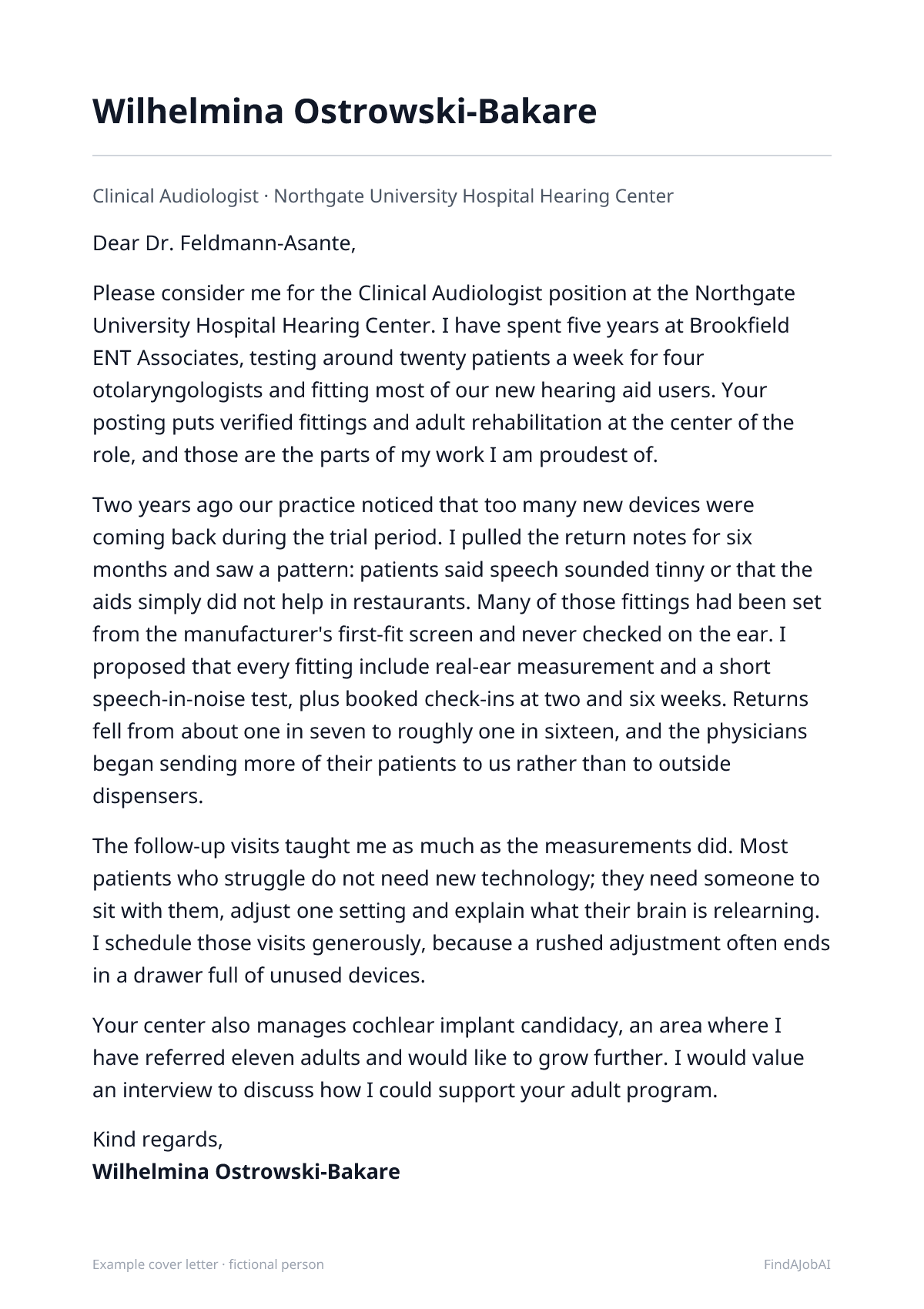
Dear Dr. Feldmann-Asante,
Please consider me for the Clinical Audiologist position at the Northgate University Hospital Hearing Center. I have spent five years at Brookfield ENT Associates, testing around twenty patients a week for four otolaryngologists and fitting most of our new hearing aid users. Your posting puts verified fittings and adult rehabilitation at the center of the role, and those are the parts of my work I am proudest of.
Two years ago our practice noticed that too many new devices were coming back during the trial period. I pulled the return notes for six months and saw a pattern: patients said speech sounded tinny or that the aids simply did not help in restaurants. Many of those fittings had been set from the manufacturer's first-fit screen and never checked on the ear. I proposed that every fitting include real-ear measurement and a short speech-in-noise test, plus booked check-ins at two and six weeks. Returns fell from about one in seven to roughly one in sixteen, and the physicians began sending more of their patients to us rather than to outside dispensers.
The follow-up visits taught me as much as the measurements did. Most patients who struggle do not need new technology; they need someone to sit with them, adjust one setting and explain what their brain is relearning. I schedule those visits generously, because a rushed adjustment often ends in a drawer full of unused devices.
Your center also manages cochlear implant candidacy, an area where I have referred eleven adults and would like to grow further. I would value an interview to discuss how I could support your adult program.
Kind regards,
Wilhelmina Ostrowski-Bakare
Example 2 · Entry level
New Au.D. graduate applying for a first staff audiologist role
Desmond finished a hospital externship this summer. The ad is for an entry-level audiologist at a pediatric and adult practice.
Example letter · fictional
Dear Ms. Thistlewood-Arrieta,
I am writing to apply for the Staff Audiologist opening at Riverbend Family Hearing. I completed my Doctor of Audiology at Ohio State University in May, followed by a twelve-month externship at Olentangy Hearing Institute, and my state license was issued last month.
Most of my externship days were adult diagnostics and fittings, but the clinic I remember best was pediatric. A three-year-old referred for speech delay would not wear headphones and cried whenever the booth door closed. My preceptor let me try a different approach: I left the door open, started with a puppet game using inserts placed while he watched a tablet, and switched to visual reinforcement when play audiometry failed. We finished enough of the test to show a mild conductive loss in both ears, and the family left with an ENT referral rather than a return visit. The experience showed me that pediatric testing depends as much on patience and creativity as on equipment.
Across the year I completed roughly fifteen evaluations a week and fitted sixty hearing aids with real-ear verification. I am still building speed on diagnostic ABR and have only observed vestibular testing, so I would welcome supervision in those areas during my first months.
Your practice serves families across a wide rural area, and I grew up in a farming county where the nearest audiologist was an hour away. I understand why clear instructions and remote follow-up matter there, and I am comfortable programming devices by video when a family cannot make the drive.
I would be glad to meet and talk about how I could help your pediatric caseload.
Sincerely,
Desmond Haraldsen-Mbeki
Example 3 · Senior or lead
Lead audiologist applying to direct audiology services for a health system
Ingeborg leads five audiologists in a two-office practice. The ad is for an audiology manager overseeing four hospital-based clinics.
Example letter · fictional
Dear Mr. Pemberton-Ayodele,
Quarrystone Regional Health is looking for an Audiology Services Manager to bring four hospital clinics onto shared standards. That is close to what I have done for the past six years at Tidewater Hearing & Balance, where I lead five audiologists and three hearing aid specialists across two offices seeing about one hundred and forty patients a week.
When the second office opened, our physicians told me that reports looked different depending on which site produced them, and that fittings from one location came back far more often. I sat down with each audiologist to compare how we tested and fitted, then wrote one protocol covering masking rules, report wording and mandatory real-ear checks. We added a monthly peer chart review where two audiologists read each other's cases. Within eighteen months the device return rate fell from twelve percent to five, and referring doctors stopped asking which office a report came from.
I also started our pediatric diagnostic service. It now handles around one hundred and sixty children a year, including natural-sleep ABR for babies referred from three birthing hospitals, and two Au.D. externs train with us every year. I meet the externs weekly to review their cases, and several have since joined hospital programs in the region. Building that service taught me how to win referrals by sending physicians clear, prompt reports.
My budget experience is limited to device inventory and manufacturer agreements. Your role includes capital equipment planning across four sites, which I would want to learn alongside your finance team.
I would be glad to discuss how a shared protocol and peer review could work across your clinics.
Respectfully,
Ingeborg Valcourt-Okafor
All three letters, and the short version below, are fictional: the people, employers and numbers are invented. Borrow the structure, never the facts.
- Prefer to write it yourself? Use the free cover letter template.
- Check your CV against the job first: the free CV score shows the missing keywords.
Why the first letter works, paragraph by paragraph
Paragraph 1: Opening
States the setting, weekly volume and physician support, then names the two priorities in the ad: verified fittings and adult rehabilitation.
Paragraph 2: The returns story
Shows the writer reviewing data, finding a cause and changing a clinic process, with a before and after figure.
Paragraph 3: Follow-up insight
Adds a counseling view of the job, which hospital programs value for adult rehabilitation.
Paragraph 4: Link to the hearing center
Links the writer's implant referrals to a service the hospital offers, so the closing request feels specific.
What the entry-level letter does differently
The graduate's letter works because it picks one pediatric session and shows problem solving under real conditions. It counts externship evaluations and fittings, is candid about limited ABR and vestibular experience, and ties a rural upbringing to the practice's patients without overclaiming.
What the senior letter does differently
A manager's letter is read for evidence that a whole team improved. The shared protocol and peer chart review show how standards were set and checked, the pediatric service shows program building, and the honest note on capital planning keeps the claims credible.
Short audiologist cover letter: an email-ready version
Many applications arrive as an email or a small text box, and a full page doesn't fit. This version runs 120 to 150 words and keeps only what a reader needs to decide whether to reply. An audiologist replies to a practice owner who asked applicants to email a brief introduction with a resume.
Short version · email · fictional128 words
Subject: Audiologist (Au.D., CCC-A) – adult fittings and tinnitus care – Leopold Sandoval-Kirchner
Hi Dr. Abernathy-Lowe,
I am interested in the Audiologist role at Clearwater Hearing Studio. I hold an Au.D. and CCC-A and have worked four years in an ENT office, where I test about twenty adults a week and fit most of our new hearing aid users.
Last year I set up a small tinnitus program: a standard questionnaire at intake, sound therapy options and a three-month check. Most of the forty patients who joined reported lower questionnaire scores at that visit, and our physicians now send tinnitus referrals straight to us.
Your studio advertises tinnitus support, so I think that experience could help you from the first week. My resume is attached, and I am free for a call on Tuesday or Thursday afternoons.
Best regards,
Leopold Sandoval-Kirchner
The short email keeps to one result that matches the practice's advertised service. It gives credentials in the first line, explains the tinnitus program in two sentences and ends with concrete availability.
Opening lines that work for audiologist cover letters
The first sentence decides whether the second gets read. Here are six openings, one for each situation you might be in. Pick the one that matches yours and swap in your own facts: every name and number below is invented.
1. You have a standout result
Too many new hearing aids were coming back during our trial period. Adding real-ear checks and two booked follow-ups cut those returns by more than half.
2. The ad names a problem you've solved
Your posting asks for an audiologist comfortable with young children. My favorite externship session ended with a reluctant three-year-old finishing his test beside an open booth door.
3. Someone referred you
Dr. Margarethe Oyelaran, who supervised my pediatric rotation, mentioned that your practice is adding a second audiologist and suggested I write to you directly.
4. You admire what they build
For four years I have tested about twenty adults a week for ENT physicians, and I would like to bring that diagnostic experience to a hospital program.
5. You're new to the field or switching into it
When our practice opened a second office, I wrote one fitting and reporting protocol so patients got the same care at both locations.
6. You have senior scope or a specialism
Forty tinnitus patients joined a simple program I built last year, and most reported lower questionnaire scores at their three-month visit.
How to write an audiologist cover letter
Five steps, in the order you'd write them. The shape stays the same for every job (a short opening, proof, a reason for this employer, a close), and what goes into each part is what changes with the role.
Read the clinic's patient mix
An ENT office, a hospital center, a pediatric practice and a private dispensing clinic each want different strengths. Look for clues in the ad, such as vestibular testing, implants or newborn screening, and choose an example from your own caseload that fits that mix, so the reader sees an immediate match.
Tell one clinical story with an outcome
Describe a fitting you rescued, a referral you made, or a difficult test you completed. Explain what you noticed, what you changed and what happened next, such as a lower return rate, a quicker ENT visit or a family leaving with a clear plan. One specific case beats a paragraph of general claims.
Show you verify and follow up
Employers increasingly expect real-ear verification and structured follow-up. Mention both inside your story rather than as a separate list, and add a figure if you have one, such as return rate or follow-up attendance, so the reader understands your standards for fitting quality and patient support.
Add counseling and communication
Hearing loss often comes with frustration, denial or worry from family members. A sentence about how you explain results, set expectations for a new device or help a reluctant patient keep trying shows the human side of the job, which interviewers weigh heavily for audiologists.
Be honest about areas still developing
New graduates and audiologists changing settings may have limited ABR, vestibular or implant experience. Say so in one sentence and describe how you plan to build the skill. Clinics trust candidates who know their limits, and it helps them plan supervision before your first day.
Audiologist cover letter do's and don'ts
Do
- Pick one patient moment that shows clinical judgment and say what happened next.
- Mention your license, credential and setting in the opening lines.
- Connect your strongest area, such as pediatrics or implants, to a service the clinic offers.
Don't
- Don't recite the standard test battery that every audiologist performs.
- Don't frame your value as hearing aid sales numbers alone.
- Don't include patient details that could identify a family.
Common audiologist cover letter mistakes
Each one is easy to make and quick to fix before you send the letter.
Listing every audiometric test you know
Reviewers assume the core battery. Use the space to show one test or fitting in action with a result.
Writing like a device salesperson
Talk about patient outcomes and follow-up first, and leave unit totals for the resume if at all.
No mention of license or certification
Name your state license and CCC-A or board certification early, since many employers screen on them.
Ignoring the setting in the ad
A hospital program and a private practice want different things. Mention the setting and connect your example to it.
Email subject lines for audiologist applications
Applying by email? Put the job title, any reference number and your name in the subject line.
- Clinical Audiologist application – verified fittings, adult rehab – Wilhelmina Ostrowski-Bakare
- Staff Audiologist – new Au.D., pediatric externship – Desmond Haraldsen-Mbeki
- Application: Audiologist, Hearing Center (Req 5720) – Wilhelmina Ostrowski-Bakare
Everything for Audiologists
- Audiologist resume exampleA full resume, plus bullet and summary examples
- Audiologist interview questions30 questions with sample answers
- Audiologist job descriptionDuties, skills and requirements
- Cover letter with no experience: templates
Other cover letter examples
Audiologist cover letter FAQ
What should an audiologist cover letter include?
Your degree, license and certification, the setting and patients you work with, one clinical example with an outcome, and a clear link to the services the clinic or hospital offers.
How does a new Au.D. graduate write a cover letter?
Lead with the externship setting and length, describe one patient session that shows judgment, count the evaluations and fittings you completed, and say honestly which areas still need supervision.
Should I mention hearing aid brands in my cover letter?
Only if the posting names them or the clinic works with one manufacturer. A short mention inside an example works better than a list of software.
How we built this page
The FindAJobAI team wrote the three example letters, the short email version, the opening lines and the advice for audiologist roles. The people, employers and numbers in the letters are invented; the structure, the kind of evidence and the order of the paragraphs are the parts to copy.
Once we track enough live audiologist job ads, this page also shows the skills they ask for most, counted the same way as our in-demand skills report.
Last reviewed on November 1, 2026.