Cybersecurity Analyst Resume Example (2026)
By FindAJobAI team Updated How we built this page
Cybersecurity analyst job ads tend to ask for the same core: a SIEM tool, incident response experience, and familiarity with a framework like NIST or MITRE ATT&CK. What separates candidates is evidence that their monitoring or response work actually caught or contained something. A cybersecurity analyst resume should say what the threat was, how it was found and what happened because of your response.
The example below is a cybersecurity analyst with four years at a healthcare IT provider and a managed security services firm. Notice how each bullet names the tool, the detection or vulnerability, and the outcome, instead of counting alerts reviewed.
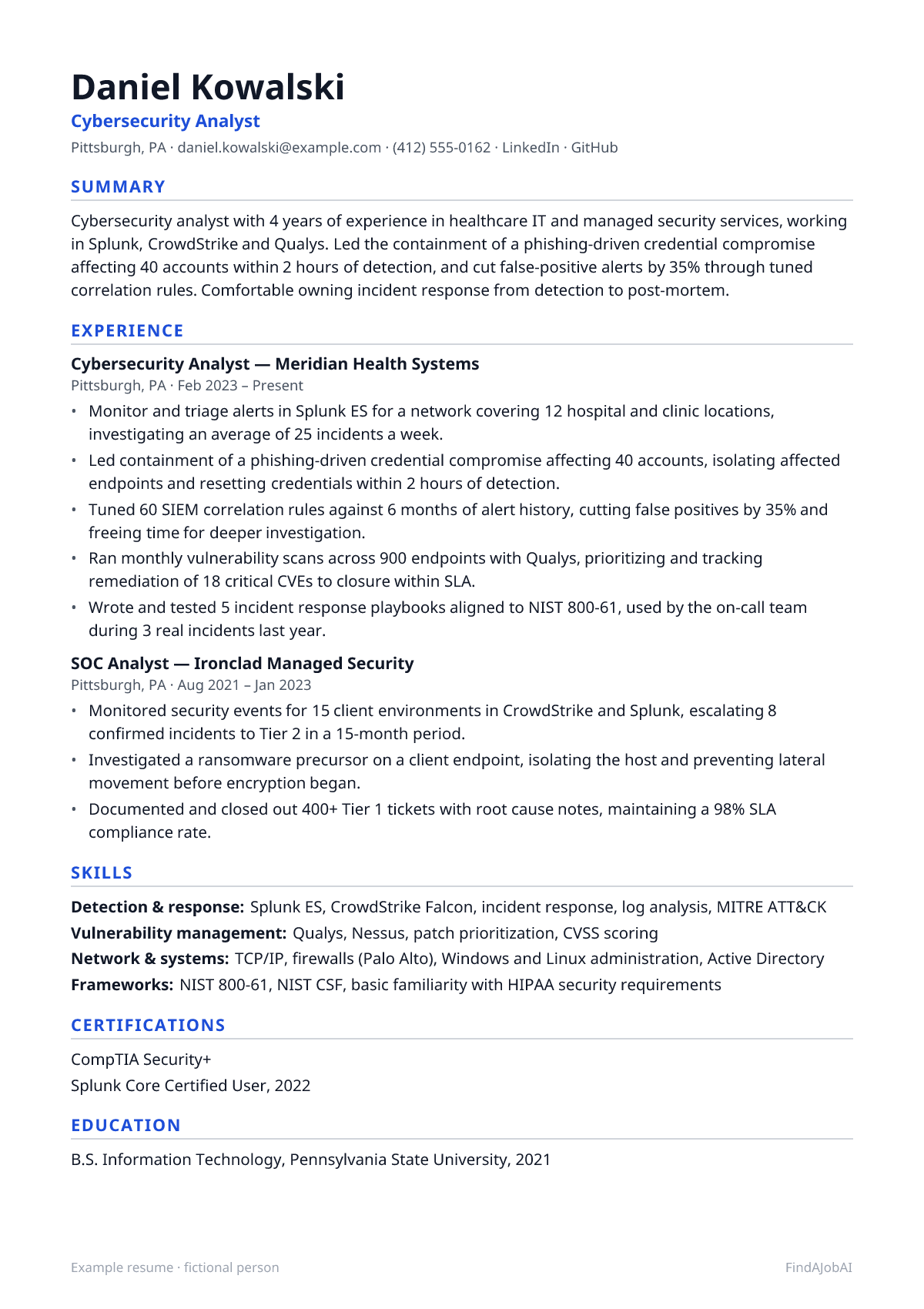
Cybersecurity Analyst resume template
This example as a one-page template: one column, standard headings and plain text, the format applicant tracking systems read most reliably.
After you sign up, Create my CV builds your own resume in this same one-column layout, from your real experience.
Mid-level cybersecurity analyst resume example
A complete one-page example for a fictional cybersecurity analyst: every bullet pairs an action with what changed because of it.
Example resume · fictional person
Daniel Kowalski
Cybersecurity Analyst
Pittsburgh, PA · [email protected] · (412) 555-0162 · LinkedIn · GitHub
Summary
Cybersecurity analyst with 4 years of experience in healthcare IT and managed security services, working in Splunk, CrowdStrike and Qualys. Led the containment of a phishing-driven credential compromise affecting 40 accounts within 2 hours of detection, and cut false-positive alerts by 35% through tuned correlation rules. Comfortable owning incident response from detection to post-mortem.
Experience
Cybersecurity Analyst, Meridian Health Systems
Pittsburgh, PA · Feb 2023 – Present
- Monitor and triage alerts in Splunk ES for a network covering 12 hospital and clinic locations, investigating an average of 25 incidents a week.
- Led containment of a phishing-driven credential compromise affecting 40 accounts, isolating affected endpoints and resetting credentials within 2 hours of detection.
- Tuned 60 SIEM correlation rules against 6 months of alert history, cutting false positives by 35% and freeing time for deeper investigation.
- Ran monthly vulnerability scans across 900 endpoints with Qualys, prioritizing and tracking remediation of 18 critical CVEs to closure within SLA.
- Wrote and tested 5 incident response playbooks aligned to NIST 800-61, used by the on-call team during 3 real incidents last year.
SOC Analyst, Ironclad Managed Security
Pittsburgh, PA · Aug 2021 – Jan 2023
- Monitored security events for 15 client environments in CrowdStrike and Splunk, escalating 8 confirmed incidents to Tier 2 in a 15-month period.
- Investigated a ransomware precursor on a client endpoint, isolating the host and preventing lateral movement before encryption began.
- Documented and closed out 400+ Tier 1 tickets with root cause notes, maintaining a 98% SLA compliance rate.
Skills
- Detection & response: Splunk ES, CrowdStrike Falcon, incident response, log analysis, MITRE ATT&CK
- Vulnerability management: Qualys, Nessus, patch prioritization, CVSS scoring
- Network & systems: TCP/IP, firewalls (Palo Alto), Windows and Linux administration, Active Directory
- Frameworks: NIST 800-61, NIST CSF, basic familiarity with HIPAA security requirements
Certifications
- CompTIA Security+
- Splunk Core Certified User, 2022
Education
- B.S. Information Technology, Pennsylvania State University, 2021
Fictional example by the FindAJobAI team: the person, employers and numbers are invented. Keep the structure; use your own work and numbers you can explain in an interview.
Entry-level cybersecurity analyst resume example
A recent IT graduate with a Security+ certification, a SOC internship and a self-built home lab standing in for professional detection experience. Education and certifications sit near the top, and the lab project ends in a specific detection rather than a list of tools installed.
Entry-level example resume · fictional person
Hannah Lindqvist
Cybersecurity Analyst
Madison, WI · [email protected] · (608) 555-0128 · LinkedIn · GitHub
Summary
Entry-level cybersecurity analyst with a B.S. in Information Technology, CompTIA Security+ certification, and a semester-long SOC internship monitoring alerts for a university network of 8,000 devices. Built a home lab running Splunk and Suricata to practice log analysis and detection. Looking for a first full-time analyst or SOC role.
Education
- B.S. Information Technology, University of Wisconsin–Madison, 2026
Experience
Security Operations Intern, University of Wisconsin–Madison, IT Security Office
Madison, WI · Jan 2026 – May 2026
- Monitored Splunk alerts for a network of 8,000 student and staff devices, triaging 10-15 alerts a day under a senior analyst's review.
- Investigated 3 confirmed phishing campaigns targeting student accounts, documenting indicators of compromise used to block 200 malicious emails.
- Ran weekly vulnerability scans with Nessus on 150 lab machines, reporting 22 outdated software installs to the desktop team.
IT Help Desk Technician, University of Wisconsin–Madison, Campus IT
Madison, WI · Sep 2024 – Dec 2025
- Resolved an average of 20 tickets a day covering account lockouts, malware cleanup and device configuration for students and faculty.
- Identified and reported 5 compromised accounts from credential-stuffing attempts, each confirmed and reset within the same day.
Skills
- Detection & monitoring: Splunk, Suricata, Wireshark, basic log analysis
- Vulnerability tools: Nessus, OpenVAS (lab use)
- Systems & networking: TCP/IP, Windows and Linux administration, Active Directory basics, firewalls (pfSense)
Certifications
- CompTIA Security+, 2025
- CompTIA Network+, 2024
Projects
- Home SOC lab (Splunk, Suricata, pfSense): built a monitored lab network and detected a simulated brute-force SSH attack within 4 minutes using custom correlation rules.
- Phishing email analysis write-ups: analyzed 10 real-world phishing samples, documenting headers, payloads and indicators of compromise in a public GitHub repo.
Senior cybersecurity analyst resume example
A lead analyst nine years in, now running detection engineering and managing a small SOC team. The bullets move from triaging alerts to building the detection program, reducing response time organization-wide and owning compliance-driven remediation.
Senior example resume · fictional person
Marcus Delgado
Senior Cybersecurity Analyst
Charlotte, NC · [email protected] · (704) 555-0191 · LinkedIn
Summary
Senior cybersecurity analyst with 9 years defending financial services environments, leading a team of 3 analysts and the SOC's detection engineering program at a regional bank. Reduced mean time to contain major incidents from 6 hours to 90 minutes, and owns remediation for the organization's annual penetration test and PCI DSS audit findings.
Experience
Senior Cybersecurity Analyst, Northgate Trust Bank
Charlotte, NC · May 2020 – Present
- Lead a team of 3 analysts covering 24/7 monitoring for a network supporting 45 branches and 2,000 employees, setting shift priorities and reviewing escalations.
- Built a detection engineering program mapping 80 Splunk correlation rules to MITRE ATT&CK, closing 12 coverage gaps identified in a red team exercise.
- Reduced mean time to contain major incidents from 6 hours to 90 minutes by rewriting the incident response runbook and adding automated containment actions.
- Own remediation tracking for the annual third-party penetration test and PCI DSS audit, closing 95% of findings within the required 90-day window.
- Led the response to a business email compromise attempt that targeted the wire transfer team, stopping a fraudulent $180,000 transfer before it cleared.
Cybersecurity Analyst, Ferris & Clarke Insurance
Charlotte, NC · Jul 2017 – Apr 2020
- Monitored and investigated alerts in QRadar for a 1,200-employee environment, handling an average of 30 incidents a month.
- Led the vulnerability management program across 1,500 endpoints, cutting the average time to patch critical CVEs from 45 to 12 days.
- Coordinated the organization's first tabletop ransomware exercise with 8 department leads, resulting in 3 updated response procedures.
SOC Analyst, Vantage Point MSSP
Raleigh, NC · Jun 2016 – Jun 2017
- Monitored security events for 20 client environments, escalating confirmed incidents to Tier 2 within a 20-minute SLA.
Skills
- Detection & response: Splunk ES, QRadar, CrowdStrike, detection engineering, MITRE ATT&CK, incident command
- Vulnerability & compliance: Qualys, Tenable, PCI DSS, SOC 2, remediation program management
- Leadership: Hiring and coaching analysts, SOC process design, executive incident reporting
Certifications
- GIAC Certified Incident Handler (GCIH)
- CISSP
Education
- B.S. Computer Science, North Carolina State University, 2016
How to write a cybersecurity analyst resume
Five steps, in the order a recruiter reads the page. The format around them stays plain for every job: one column, standard headings, newest role first.
Header: name, target title and links
Use “Cybersecurity Analyst” or “SOC Analyst” to match how recruiters search, and list your certifications (Security+, CySA+, GIAC) prominently since many ATS filters and recruiters screen on them directly.
Summary: what you do and your best proof
Name your core tools (SIEM, EDR, vulnerability scanner), the type of environment you've defended, and one concrete outcome: an incident contained, a vulnerability program improved. Skip lines like “passionate about security”; every applicant claims that.
Experience: newest first, a result in every bullet
Open each bullet with the detection method or task, then the tool, then the outcome: what was found, what you did, and what happened as a result. Counting alerts reviewed says little; one real incident with a clear response says a lot.
Skills: grouped, in the ad's words
Group them into detection and response tools, vulnerability and compliance tools, and networking or systems fundamentals. List the exact SIEM and EDR platforms named in the job ad if you've used them.
Education and certifications
List your degree with the year, and put certifications in their own line near the top if you hold Security+, CySA+, GCIH or similar. Without professional experience, add a Projects section describing a home lab or CTF work with a specific detection or finding.
Skills to put on a cybersecurity analyst resume
Hard skills are the tools and methods of the job; soft skills are how you work with people. Each comes with one way to prove it, because a skill named only in a list counts for little. Add the ones you really have.
Hard skills
- SIEM tools (Splunk, QRadar, Sentinel)
- Name the platform and show a bullet where you tuned rules, triaged alerts or investigated a specific incident with it.
- EDR tools (CrowdStrike, SentinelOne)
- Point to an endpoint isolation or containment action you took and how quickly you acted.
- Incident response
- Describe a real incident: how it was detected, what you did, and the outcome, tied to a framework like NIST 800-61 if relevant.
- Vulnerability management
- Give the scanning tool, the number of endpoints or CVEs, and your remediation turnaround time.
- Log analysis
- Name the log sources you work with (firewall, endpoint, auth) and a finding you traced through them.
- MITRE ATT&CK
- Mention mapping detections or incidents to specific tactics or techniques, not just that you're familiar with the framework.
- Network security (firewalls, IDS/IPS)
- Name the platform (Palo Alto, Suricata) and a rule or configuration change you made and its effect.
- Threat intelligence
- Describe an indicator of compromise you sourced or shared and the detection it fed.
- Scripting (Python, PowerShell)
- Point to a specific automation, like log parsing or alert enrichment, and the manual work it replaced.
- Compliance frameworks (NIST, PCI DSS, HIPAA)
- Name the framework and a finding or audit you helped close, with the remediation window if you have one.
- Active Directory / identity security
- Describe an investigation involving credential compromise, privilege escalation or account lockout response.
- Cloud security (AWS, Azure)
- Name the cloud provider and a misconfiguration or alert you investigated there, if applicable to your experience.
Soft skills
- Composure under pressure
- Describe an active incident you worked and how you kept investigation and communication moving at once.
- Communication under incident conditions
- Mention a status update or executive summary you wrote during a live incident, and who it went to.
- Attention to detail
- Give an example of a subtle indicator you caught that a less careful review would have missed.
- Prioritization
- Describe your daily alert or ticket volume and how you decided what got investigated first.
- Collaboration across teams
- Name a cross-team response, like IT, legal or a business unit, and your role in it.
- Documentation discipline
- Point to a playbook, runbook or post-mortem you wrote that the team reused later.
- Continuous learning
- Mention a new technique, CVE class or threat group you studied and applied to your detection work.
Cybersecurity Analyst resume bullet examples: weak vs strong
The same work, written two ways. The strong version names the tool, the scope and a result; the numbers are examples, yours must be real.
Weak: Monitored security alerts.
Strong: Triaged an average of 25 daily alerts in Splunk ES across 12 locations, escalating confirmed threats within a 30-minute SLA.
Gives volume, tool and the service standard met.
Weak: Responded to incidents.
Strong: Led containment of a credential compromise affecting 40 accounts, isolating endpoints and resetting credentials within 2 hours of detection.
Names the incident, the scale and the response time.
Weak: Ran vulnerability scans.
Strong: Ran monthly Qualys scans across 900 endpoints and tracked 18 critical CVEs to remediation within SLA.
Turns a routine task into a measurable outcome.
Weak: Worked with SIEM tools.
Strong: Tuned 60 Splunk correlation rules against 6 months of alert history, cutting false positives by 35%.
Shows depth of SIEM work and its effect on the team's time.
Weak: Wrote documentation.
Strong: Wrote 5 incident response playbooks aligned to NIST 800-61, used by the on-call team during 3 real incidents.
Shows the documentation was actually used, not just filed.
Weak: Investigated a security issue.
Strong: Investigated a ransomware precursor on a client endpoint, isolating the host before encryption began and preventing lateral movement.
Specific threat, action taken, and the damage avoided.
15 more cybersecurity analyst resume bullet examples
Grouped by area of the job, so you can find the ones closest to your work. Keep the shape (action, scope, result) and replace the invented numbers with your own.
Detection and alert triage
- Triaged 1,200 Splunk alerts over a quarter, confirming 34 as true positives and closing the rest with documented false-positive reasoning.
- Built 15 new correlation rules targeting credential-stuffing patterns, catching 6 attempted account takeovers before they succeeded.
- Reduced average alert triage time from 25 to 9 minutes by adding enrichment fields to the SIEM's alert dashboard.
- Identified a beaconing pattern in proxy logs that led to the discovery of malware on 3 endpoints missed by antivirus.
Incident response
- Led the technical response to a ransomware attempt on 2 file servers, isolating affected systems and restoring from backup with 6 hours of downtime instead of a projected 3 days.
- Coordinated with legal and HR during an insider data exfiltration investigation, preserving forensic evidence later used in a personnel action.
- Wrote the post-incident report for a DDoS attack that took a customer portal offline for 40 minutes, with 4 recommendations adopted by the infrastructure team.
- Ran a tabletop exercise simulating a business email compromise for 10 finance staff, surfacing a gap in wire transfer verification that was fixed within a month.
Vulnerability and patch management
- Tracked remediation of 45 critical and high CVEs across 600 servers, closing 90% within the 30-day SLA.
- Partnered with the infrastructure team to patch a zero-day affecting 80 externally facing systems within 72 hours of disclosure.
- Built a risk-based prioritization model for vulnerability scan results, cutting the backlog of open findings by 60% in 2 quarters.
- Retired 12 end-of-life Windows Server 2012 hosts after mapping each to its owner, removing 70 open findings from the quarterly scan report.
Compliance and reporting
- Prepared evidence for a SOC 2 audit covering 25 security controls, with zero major findings for the second year running.
- Presented a monthly security metrics report to 6 department heads, translating alert and incident counts into plain-language risk trends.
- Mapped the organization's detection coverage against 40 MITRE ATT&CK techniques, identifying and closing 9 gaps.
Cybersecurity Analyst resume summary examples
Two or three lines on what you do and your strongest proof. Start from the one closest to your level and use your own facts.
Cybersecurity analyst with a Security+ certification and a semester-long SOC internship monitoring alerts for a university network. Built a home lab running Splunk and Suricata to practice detection and log analysis. Strong foundation in networking and Linux administration.
Cybersecurity analyst with 4 years in healthcare IT and managed security services, working in Splunk, CrowdStrike and Qualys. Led containment of a credential compromise affecting 40 accounts and cut false-positive alerts by 35% through SIEM tuning.
Senior cybersecurity analyst with 9 years defending a financial services environment, leading a team of 3 analysts and the SOC's detection engineering program. Reduced mean time to contain major incidents from 6 hours to 90 minutes and owns the organization's annual penetration test remediation.
Common cybersecurity analyst resume mistakes
Each one is easy to make and quick to fix before you apply.
Listing tools with no incident attached
Splunk, CrowdStrike and Qualys in Skills show what you can use; the bullets must show what you found or stopped with them. Pair each tool with a real detection or investigation.
Counting alerts instead of outcomes
“Reviewed 500 alerts a month” invites the question of what mattered among them. Name one confirmed incident and how you responded.
Vague incident descriptions
“Responded to security incidents” could mean anything. Name the type of incident (phishing, ransomware, credential compromise), your action and the result, without violating any NDA.
Missing certifications
Many cybersecurity ATS filters and recruiters screen for Security+, CySA+ or GIAC certifications specifically. List them near your summary, not buried at the bottom.
No framework or compliance context
If the job ad mentions NIST, PCI DSS or HIPAA, show familiarity with a specific finding, control or mapping you worked on rather than just naming the framework.
ATS tips for a cybersecurity analyst resume
Applicant tracking systems turn your file into text that recruiters search, mostly for the skills and titles in the ad. They rarely reject a resume on their own; one that parses badly or misses the ad's words just doesn't come up.
- Name the SIEM and EDR tools you've used (Splunk, CrowdStrike, Sentinel); most ads ask for specific platforms.
- Describe at least one real incident with the detection method, your action and the outcome, not just alert counts.
- Mention the framework you work against (NIST, MITRE ATT&CK, CIS Controls) if the job ad references compliance.
- Quantify vulnerability work by CVEs remediated or endpoints covered, not just "ran scans".
- List relevant certifications (Security+, CySA+, GIAC) near the top; many ATS filters screen on these directly.
For the format itself, run the free ATS resume checklist.
Everything for Cybersecurity Analysts
- Cybersecurity Analyst cover letter examplesThree example letters and a short email version
- Cybersecurity Analyst interview questions30 questions with sample answers
- Cybersecurity Analyst job descriptionDuties, skills and requirements
- How to tailor your resume without lying
Other resume examples
Cybersecurity Analyst resume FAQ
What certifications matter most for a cybersecurity analyst resume?
CompTIA Security+ is the common baseline; CySA+, GIAC GCIH or GSEC, and CEH carry more weight for incident response and detection roles. List the ones you hold near your summary or in a dedicated section.
How do I break into cybersecurity analyst roles with no professional experience?
Build a home lab with a SIEM and generate your own logs to practice detection, pursue Security+, and count help desk or sysadmin work as relevant experience since it shows the underlying systems knowledge.
Should I describe real incidents on a cybersecurity resume if they're under NDA?
Yes, describe the type of incident, your actions and the outcome without naming the employer's clients or specifics that would violate confidentiality; the pattern of response matters more than the company name.
How we built this page
The FindAJobAI team wrote the three example resumes, the bullets, the skills and the advice for cybersecurity analyst roles. The people, employers and numbers in the examples are invented; the structure, the tools and the way each bullet is built are the parts to copy.
Once we track enough live cybersecurity analyst job ads, this page also shows the skills they ask for most, counted the same way as our in-demand skills report.
Last reviewed on November 1, 2026.