Policy Analyst Resume Example (2026)
By FindAJobAI team Updated How we built this page
Policy analyst job ads tend to ask for the same core: research methods, writing for non-experts, and the ability to work with lawmakers, agencies or advocacy groups. What separates candidates is evidence that their analysis changed a decision, not just that they produced a report. A policy analyst resume should say who read your memo and what they decided because of it.
The example below is a policy analyst with five years split between a state legislative office and a nonprofit research institute. Notice how each bullet names the issue, the method and the outcome, instead of counting reports written.
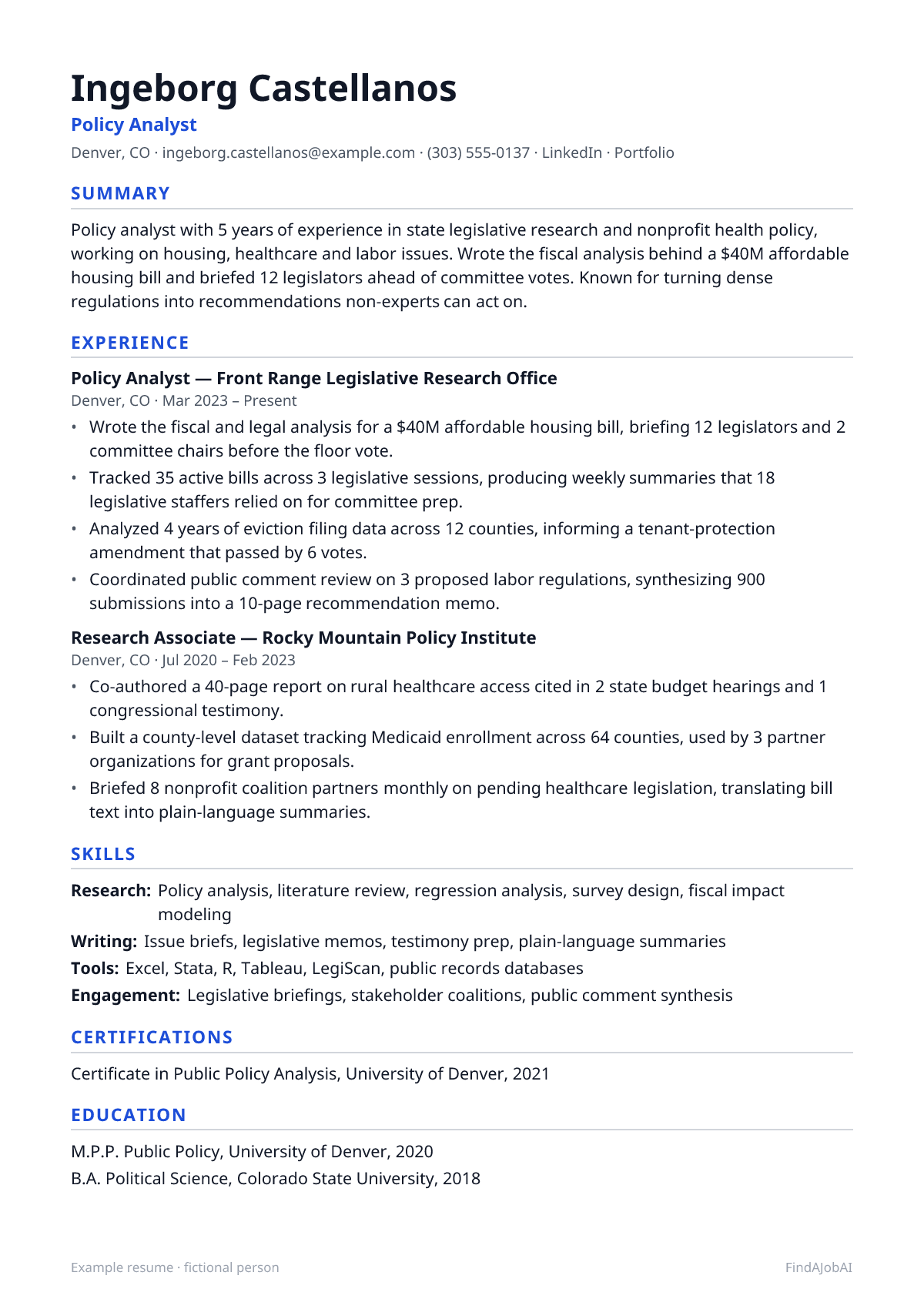
Policy Analyst resume template
This example as a one-page template: one column, standard headings and plain text, the format applicant tracking systems read most reliably.
After you sign up, Create my CV builds your own resume in this same one-column layout, from your real experience.
Mid-level policy analyst resume example
A complete one-page example for a fictional policy analyst: every bullet pairs an action with what changed because of it.
Example resume · fictional person
Ingeborg Castellanos
Policy Analyst
Denver, CO · [email protected] · (303) 555-0137 · LinkedIn · Portfolio
Summary
Policy analyst with 5 years of experience in state legislative research and nonprofit health policy, working on housing, healthcare and labor issues. Wrote the fiscal analysis behind a $40M affordable housing bill and briefed 12 legislators ahead of committee votes. Known for turning dense regulations into recommendations non-experts can act on.
Experience
Policy Analyst, Front Range Legislative Research Office
Denver, CO · Mar 2023 – Present
- Wrote the fiscal and legal analysis for a $40M affordable housing bill, briefing 12 legislators and 2 committee chairs before the floor vote.
- Tracked 35 active bills across 3 legislative sessions, producing weekly summaries that 18 legislative staffers relied on for committee prep.
- Analyzed 4 years of eviction filing data across 12 counties, informing a tenant-protection amendment that passed by 6 votes.
- Coordinated public comment review on 3 proposed labor regulations, synthesizing 900 submissions into a 10-page recommendation memo.
Research Associate, Rocky Mountain Policy Institute
Denver, CO · Jul 2020 – Feb 2023
- Co-authored a 40-page report on rural healthcare access cited in 2 state budget hearings and 1 congressional testimony.
- Built a county-level dataset tracking Medicaid enrollment across 64 counties, used by 3 partner organizations for grant proposals.
- Briefed 8 nonprofit coalition partners monthly on pending healthcare legislation, translating bill text into plain-language summaries.
Skills
- Research: Policy analysis, literature review, regression analysis, survey design, fiscal impact modeling
- Writing: Issue briefs, legislative memos, testimony prep, plain-language summaries
- Tools: Excel, Stata, R, Tableau, LegiScan, public records databases
- Engagement: Legislative briefings, stakeholder coalitions, public comment synthesis
Certifications
- Certificate in Public Policy Analysis, University of Denver, 2021
Education
- M.P.P. Public Policy, University of Denver, 2020
- B.A. Political Science, Colorado State University, 2018
Fictional example by the FindAJobAI team: the person, employers and numbers are invented. Keep the structure; use your own work and numbers you can explain in an interview.
Entry-level policy analyst resume example
A recent M.P.P. graduate with one legislative internship and a thesis on education funding. Education sits right under the summary, and the internship bullets lean on specific bills and committee audiences rather than years of tenure.
Entry-level example resume · fictional person
Zbigniew Okafor-Lindqvist
Policy Analyst
Sacramento, CA · [email protected] · (916) 555-0163 · LinkedIn · Portfolio
Summary
Entry-level policy analyst with an M.P.P. focused on education finance and a legislative internship analyzing school funding bills. Built a fiscal model comparing 3 funding formulas and summarized 15 bills for committee staff during a full session. Strong in research methods, fiscal modeling and plain-language writing.
Education
- M.P.P. Public Policy, University of California, Davis, 2026
- B.A. Economics, Sacramento State University, 2024
Experience
Legislative Policy Intern, State Capitol Education Policy Office
Sacramento, CA · Jan 2026 – May 2026
- Summarized 15 education bills into 1-page briefs used by 4 committee staffers during weekly hearing prep.
- Built a fiscal model in Excel comparing 3 school funding formulas, which the committee chair's office requested for a staff meeting.
- Compiled public comment on a proposed charter school bill, synthesizing 120 submissions into a 4-page summary memo.
Research Assistant, Sacramento State University, School of Public Policy
Sacramento, CA · Sep 2024 – Dec 2025
- Analyzed 8 years of per-pupil spending data across 40 districts for a faculty research project on funding equity.
- Coded and cleaned a 25,000-row survey dataset on teacher retention, cutting the professor's analysis time by half.
Skills
- Research: Policy analysis, literature review, fiscal impact modeling, basic regression
- Writing: Issue briefs, legislative summaries, plain-language memos
- Tools: Excel, R (basic), LegiScan, public records databases
Projects
- Education funding gap memo (capstone): analyzed 5 years of district-level data to show a $9M underfunding pattern in rural districts and proposed a formula fix.
- Housing voucher policy brief (coursework): compared voucher utilization rates across 3 cities and recommended an outreach change later cited by a local nonprofit.
Senior policy analyst resume example
A senior analyst ten years in, now leading a small team and advising state leadership directly. The bullets move from writing individual briefs to setting the fiscal framework behind major funding decisions and managing other analysts.
Senior example resume · fictional person
Hyacinth Dubrovnik-Mwangi
Senior Policy Analyst
Albany, NY · [email protected] · (518) 555-0192 · LinkedIn
Summary
Senior policy analyst with 10 years advising state leadership on healthcare and labor policy, leading a team of 3 analysts. Has briefed 2 governors' offices on Medicaid reform and shaped the fiscal framework behind $200M in annual program funding across 3 budget cycles.
Experience
Senior Policy Analyst, Albany State Budget Analysis Office
Albany, NY · Jun 2020 – Present
- Lead a team of 3 analysts covering healthcare, labor and housing policy, setting research priorities each legislative session.
- Shaped the fiscal framework behind $200M in annual Medicaid program funding across 3 budget cycles, briefing 2 governors' offices directly.
- Negotiated a data-sharing agreement across 4 state agencies that cut the time to produce a cross-agency fiscal note from 6 weeks to 10 days.
- Directed the analysis behind a labor classification rule change affecting 85,000 gig workers, presented to the state labor commissioner.
- Mentor 3 junior analysts on fiscal modeling and legislative writing, 2 of whom were promoted within 18 months.
Policy Analyst, Mohawk Valley Policy Center
Albany, NY · Aug 2016 – May 2020
- Co-authored a report on paid family leave financing cited in 3 legislative hearings and adopted into a 2019 bill's funding structure.
- Tracked 60 bills a session across healthcare and labor, flagging fiscal inconsistencies in 8 that were corrected before committee votes.
- Built relationships with 15 advocacy and labor groups, coordinating joint testimony on 4 major bills.
Research Analyst, Hudson Valley Public Health Alliance
Poughkeepsie, NY · Jul 2014 – Jul 2016
- Analyzed county health department budgets across 12 counties, identifying funding gaps used in a regional advocacy campaign.
- Wrote plain-language summaries of 20 state health regulations for a coalition of 30 community health workers.
Skills
- Research: Fiscal impact modeling, regression analysis, policy evaluation, program budgeting
- Leadership: Managing analysts, cross-agency negotiation, executive briefings, mentoring
- Tools: Stata, R, Excel, Tableau, state fiscal databases
Education
- M.P.P. Public Policy, SUNY Albany, 2014
- B.A. Economics, Cornell University, 2012
How to write a policy analyst resume
Five steps, in the order a recruiter reads the page. The format around them stays plain for every job: one column, standard headings, newest role first.
Header: name, target title and links
Use the title “Policy Analyst” and name your issue area (healthcare, housing, labor) in the headline or summary, since policy work varies a lot by domain and ads usually target one.
Summary: what you do and your best proof
Name your issue area, your core methods (fiscal modeling, legislative research) and one result: a bill, budget line or decision your analysis shaped. Skip lines like “passionate about public service”; they fit every applicant in the field.
Experience: newest first, a result in every bullet
Open each bullet with the issue or bill, then the method and who acted on the finding. A recommendation that changed a vote or a funding line says more than a count of reports or memos produced.
Skills: grouped, in the ad's words
Group them into research methods, writing formats and tools (Stata, R, Excel). Name the specific legislative or regulatory process you've worked in, like committee hearings or public comment periods, since ads often ask for that directly.
Education and certifications
List your degree with the year; an M.P.P. or similar is often expected but not always required. Without full-time policy experience, add a Projects section with one memo or brief on a real issue, stating its data, method and recommendation.
Skills to put on a policy analyst resume
Hard skills are the tools and methods of the job; soft skills are how you work with people. Each comes with one way to prove it, because a skill named only in a list counts for little. Add the ones you really have.
Hard skills
- Fiscal impact modeling
- Name the bill or program you modeled and the funding figure your analysis produced.
- Policy analysis
- Give the issue area and the recommendation your analysis led to, with who adopted it.
- Legislative tracking
- State how many bills you tracked in a session and one fiscal or legal issue you flagged.
- Stakeholder briefings
- Name the audience (legislators, agency staff) and a specific outcome from the briefing.
- Regression analysis
- Describe the dataset and the relationship you tested, with the finding in plain terms.
- Survey design
- Give the sample size and the policy question the results answered.
- Public comment synthesis
- State how many submissions you reviewed and the recommendation that came out of it.
- Plain-language writing
- Name a dense regulation or bill you translated and the audience it reached.
- Stata or R
- Point to the analysis you ran in it, like a fiscal model or an equity study, not just that you know the tool.
- Grant or budget analysis
- Give the dollar amount involved and the decision your analysis informed.
- Testimony preparation
- Name the hearing and whose testimony you prepared or supported.
- Cross-agency coordination
- Count the agencies involved and what the coordination produced, like a shared dataset.
Soft skills
- Translating complexity
- Describe a dense bill or regulation you turned into a short memo and who used it.
- Building coalitions
- Give the number of groups you aligned around one position and the result.
- Working under political pressure
- Describe a sensitive issue you analyzed neutrally despite competing stakeholder interests.
- Attention to detail
- Name a fiscal or legal error you caught before a bill reached committee.
- Persuasive writing
- Point to a brief or memo that changed a vote, a funding line or a public position.
- Prioritization under deadline
- Give your session bill volume and how you decided which got full analysis.
- Nonpartisan framing
- Describe a politically contested issue you presented with balanced, fact-based framing.
Policy Analyst resume bullet examples: weak vs strong
The same work, written two ways. The strong version names the tool, the scope and a result; the numbers are examples, yours must be real.
Weak: Researched policy issues.
Strong: Researched 3 states' paid leave policies and modeled their fiscal impact if adopted in Colorado, informing a bill's funding mechanism.
Names the scope, method and the decision it fed.
Weak: Wrote policy briefs.
Strong: Wrote a 6-page brief on zoning reform that a committee chair cited twice during floor debate.
Specific document with evidence it was actually used.
Weak: Worked with stakeholders.
Strong: Built a coalition of 9 advocacy groups around a single shared position on rent stabilization, resolving 3 competing drafts into one.
Shows influence and the scale of alignment achieved.
Weak: Analyzed data for reports.
Strong: Analyzed 5 years of school funding data across 180 districts, identifying a formula gap that redirected $12M in the next budget cycle.
Data scale tied to a concrete funding outcome.
Weak: Tracked legislation.
Strong: Tracked 40 bills across a session, flagging 6 with conflicting fiscal notes before they reached committee.
Volume plus a specific catch that mattered.
Weak: Presented findings to officials.
Strong: Briefed 2 state senators ahead of a hearing, after which both offices adopted language from the brief into their floor remarks.
Direct evidence the briefing changed what was said publicly.
15 more policy analyst resume bullet examples
Grouped by area of the job, so you can find the ones closest to your work. Keep the shape (action, scope, result) and replace the invented numbers with your own.
Legislative and fiscal analysis
- Modeled the 5-year fiscal impact of a proposed childcare subsidy expansion, projecting a $28M cost that reshaped the bill's phase-in schedule.
- Flagged a $6M discrepancy between 2 agencies' fiscal notes on the same bill, triggering a joint review before the floor vote.
- Analyzed 10 years of unemployment insurance claims data to model the cost of a proposed benefit increase, informing the final funding level.
- Wrote the fiscal note for a $15M workforce training bill, cited directly in the committee's final report.
Research and writing
- Authored a 25-page report on rural broadband access gaps across 40 counties, cited in a state infrastructure funding hearing.
- Wrote 30 plain-language bill summaries over one session, used by a coalition of 12 advocacy groups with no in-house policy staff.
- Synthesized 600 public comments on a proposed emissions rule into a 15-page recommendation memo adopted with minor changes.
- Co-authored a peer-reviewed brief on housing voucher utilization that informed a $5M outreach program redesign.
Stakeholder and legislative engagement
- Briefed 6 legislative staffers weekly during session on 20 active bills, becoming the office's go-to summary source.
- Coordinated a coalition of 10 nonprofit partners around unified testimony for a tenant protection bill that passed by 4 votes.
- Presented fiscal findings to a 15-member legislative committee, after which 2 amendments incorporated the recommended funding language.
Data and program evaluation
- Evaluated a pilot job-training program across 8 sites, finding a 30% completion rate gap that led to a redesigned curriculum.
- Built a county-level dashboard tracking 50 health indicators, used by 3 state agencies for annual budget planning.
- Audited program spending data across 20 grant recipients, identifying $1.2M in funds that were reallocated the following cycle.
- Analyzed enrollment trends across 64 counties in a Medicaid expansion program, projecting a budget shortfall 2 quarters before it occurred.
Policy Analyst resume summary examples
Two or three lines on what you do and your strongest proof. Start from the one closest to your level and use your own facts.
Policy analyst with an M.P.P. and a legislative internship analyzing education funding bills. Built a fiscal model comparing 3 school funding formulas and summarized 15 bills for committee staff during session. Strong in research methods and plain-language writing.
Policy analyst with 5 years in state legislative research and nonprofit health policy. Wrote the fiscal analysis behind a $40M housing bill and briefed 12 legislators ahead of committee votes.
Senior policy analyst with 10 years advising state leadership on healthcare and labor policy. Leads a team of 3 analysts, has briefed 2 governors' offices, and shaped the fiscal framework behind $200M in annual program funding.
Common policy analyst resume mistakes
Each one is easy to make and quick to fix before you apply.
No named issue area
Housing, healthcare and labor policy analysts need different knowledge. Name your domain so the ad's reader knows you fit.
Counting reports instead of decisions
“Wrote 20 policy briefs” doesn't show impact. Name one brief or memo that a legislator or agency acted on.
Dense, jargon-heavy bullets
If a bullet reads like regulatory text, it hides what you actually did. Write it the way you'd explain it to a non-expert stakeholder.
Hiding quantitative skills
Fiscal modeling and data analysis are often decisive differentiators. Name the tool and the scale of the dataset you worked with.
No mention of who used the analysis
A memo with no stated audience could have gone unread. Name the legislator, agency or coalition that received and acted on it.
ATS tips for a policy analyst resume
Applicant tracking systems turn your file into text that recruiters search, mostly for the skills and titles in the ad. They rarely reject a resume on their own; one that parses badly or misses the ad's words just doesn't come up.
- Name the issue area (housing, healthcare, labor) your ads target; policy work varies a lot by domain.
- Show impact by naming who read or acted on your analysis, not just how many reports you produced.
- If you worked with data, name the dataset's scale and the tool (Stata, R, Excel) you used to analyze it.
- Mention specific legislative or regulatory processes you supported, like committee hearings or public comment periods.
- Quantify stakeholder work with the number of groups, legislators or partners you coordinated.
For the format itself, run the free ATS resume checklist.
Everything for Policy Analysts
- Policy Analyst cover letter examplesThree example letters and a short email version
- Policy Analyst interview questions30 questions with sample answers
- Policy Analyst job descriptionDuties, skills and requirements
- How to tailor your resume without lying
Other resume examples
Policy Analyst resume FAQ
What skills should a policy analyst put on a resume?
Research methods, data analysis, plain-language writing and stakeholder engagement, plus familiarity with the legislative or regulatory process. Show each with a bill, report or briefing it supported.
How do I become a policy analyst with no legislative experience?
Count internships, thesis research or advocacy volunteer work that involved analyzing an issue and writing recommendations, and build one public policy memo on a real issue as a portfolio piece.
Should a policy analyst resume mention specific bills or legislation?
Yes, when you can name your role precisely, such as drafting fiscal language or briefing a sponsor. It's concrete evidence your work reached a real decision.
How we built this page
The FindAJobAI team wrote the three example resumes, the bullets, the skills and the advice for policy analyst roles. The people, employers and numbers in the examples are invented; the structure, the tools and the way each bullet is built are the parts to copy.
Once we track enough live policy analyst job ads, this page also shows the skills they ask for most, counted the same way as our in-demand skills report.
Last reviewed on November 1, 2026.